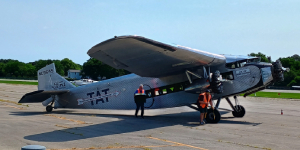
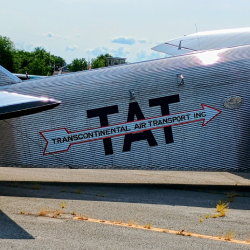
1928 FORD TRIMOTOR AIRPLANE, Put-In-Bay, Ohio

Expedition Team: Dave Miller, Rosie Miller

Date: August 2, 2025

This was a surprise find. The 1928 plane, normally housed at Port Clinton, Ohio Museum/Airfield, was at the Put-In-Bay Airport and giving tours and plane rides around the island and back. The plane reminded me of the plane at the beginning of the second Indianan Jones movie. The Tri-Motor is called the “Tin Goose”. This well-maintained plane will be 100 years old in three years.

NATIONAL ROAD Ohio

Expedition Team: Dave Miller, Rosie Miller, Tyler Kaltenbach

Date: August 2024

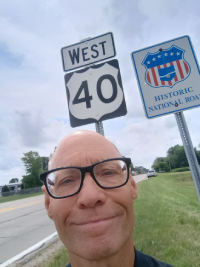
I traveled on this famous road many times in Ohio, Indiana and Pennsylvania. The National Road, in many places known as Route 40, was built between 1811 and 1834 to reach the western settlements. It was the first federally funded road in U.S. history. George Washington and Thomas Jefferson believed that a trans-Appalachian Road was necessary for unifying the young country. In 1806 Congress authorized construction of the road and President Jefferson signed the bill. In 1811 the first contract was awarded and the first 10 miles of road built. Tollgates and tollhouses were then built by the states, with the federal government taking responsibility for road repairs.

The road, also called the Cumberland Road, National Pike and other names, became Main Street in these early settlements, earning the nickname “The Main Street of America.” The height of the National Road’s popularity came in 1825 when it was celebrated in song, story, painting and poetry. During the 1840s popularity soared again. Travelers and drovers, westward bound, crowded the inns and taverns along the route. Huge Conestoga wagons hauled produce from frontier farms to the East Coast, returning with staples such as coffee and sugar for the western settlements. Thousands moved west in covered wagons and stagecoaches traveled the road keeping to regular schedules.

In Ohio, the byway extends 225 miles from the West Virginia border to the Indiana state line.

PRESIDENT’S WIFE BIRTHPLACE Wytheville, Virginia

Expedition Team: Dave Miller

Date: August 17, 2024

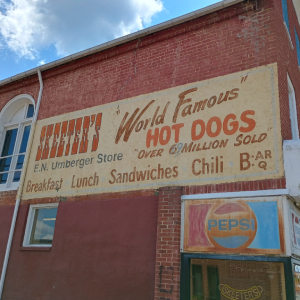
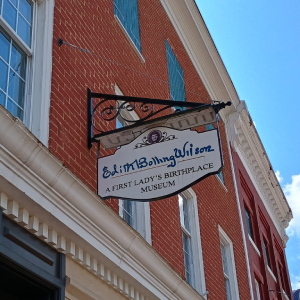
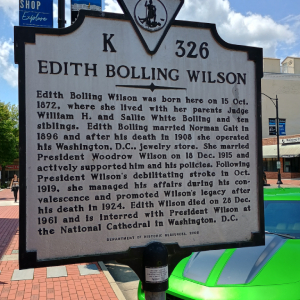
Well, one roadside attraction failed but a second one was successful. In this old building along Main Street on the historic Daniel Boone Trail Highway, was Skeeters World Famous Hot Dogs, unique creations (established in 1925 and ranked in the top 64 hot dogs in the USA) which I was going to go off the grid and eat. We had left Raleigh, North Carolina and I put off lunch an extra two hours to eat there and I was hungry. When we pulled up, the restaurant was closed. No Skeeterdogs today. However, next door and above was the birthplace of President Woodrow Wilson’s wife Edith, along with an historical marker out front. Edith Bolling Wilson was born here in 1872 and married the President in 1915.

THE FLORENTINE HOTEL Germantown, Ohio

Expedition Team: Dave Miller, Rosie Miller

Date: October 1, 2022

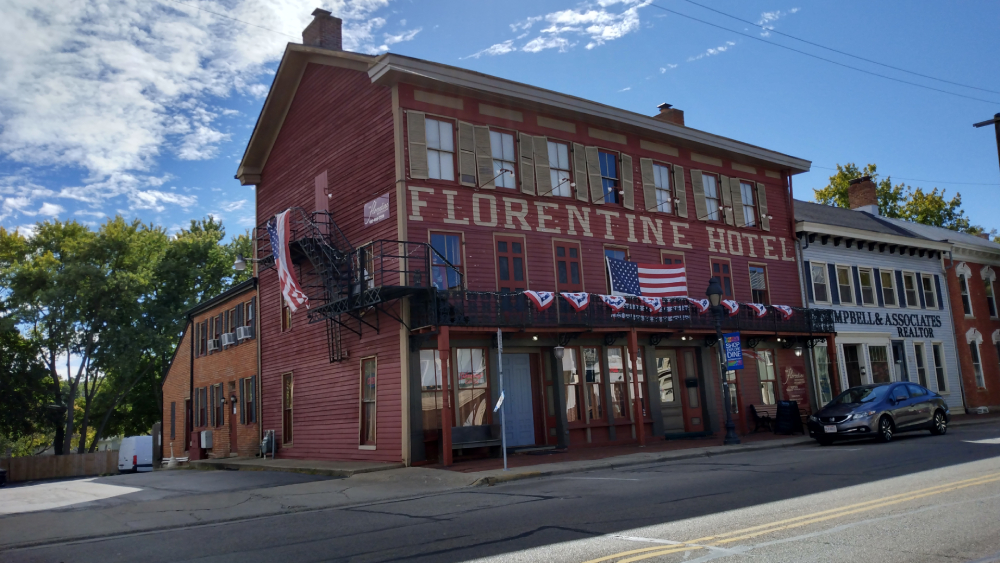
This is Ohio’s second oldest Inn and believed to be a stagecoach stop.  Built between 1814 and 1816 by Germantown founder and town Proprietor Philip Gunckel, the original hotel had three sections and the first-floor fireplace in the banquet room is the original fireplace. In 1862 it was operated by William Leighty who changed the name to the Leighty House. Famous American Henry Clay and several others gave speeches from the iron balcony. The name was changed back to The Florentine Hotel in 1911. It was always the social hub of the town. Today it is an American steakhouse restaurant. Recently, Rosie and I ate here, and I enjoyed for the first time, an appetizer of fried green tomatoes.

ON THE TRAIL OF JOHN DILLINGER – DILLINGER’S JAIL Crown Point, Indiana

Expedition Team:  Dave Miller, Rosie Miller

August 3, 2021

We stopped by the old Lake County Sheriff’s House and Jail built in 1882.  The jail on the southeast of Courthouse Square was 50’ x 120’ with six cells. Photo #2, #3 & #4 show the jail today. Photo #6 & #7 show the jail in 1934 hours after Dillinger escaped. 

The jail gained national interest when Public Enemy #1 John Dillinger carved a gun out of wood (Photo#8) and used it to escape on March 3, 1934 along with inmate Herbert Youngblood. They stole guns from the jail, Sheriff Lillian Holley’s 1933 Ford V-8 car from Main Street Garage two buildings north of the jail, took three hostages and headed for Chicago where the car was abandoned (Photo#5).

OHIO’S OLDEST OPERATING INN West Union, Ohio

Expedition Team: Dave Miller, Rosie Miller

Date: April 30, 2021

The Olde Wayside Inn in downtown West Union is Ohio’s Oldest Standing Inn Still in Use. Built in 1804 as the Bradford Inn by General David Bradford, it served travelers along Zane’s Trace, the original route from Maysville, Kentucky to Wheeling, West Virginia. Notable visitors to the tavern included President Andrew Jackson in 1829 on his way to his inauguration, Mexican General Santa Anna in 1836 and American statesman Henry Clay. Rooms are only $65 a night!!!

GREAT MORAINE TROLLEY/AIRPLANE RACE

Pathe Sound News filmed a race challenge between an interurban trolley and a biplane in Moraine in 1930. The film was shown all across the country at movie theaters. For you younger readers, since there were no televisions in 1930, major news events were filmed and shown at movie theaters prior to the feature film.

The race began at Moraine Flying Field (Photo#1) which was located just east of the Springboro Pike/Northlawn Blvd intersection and just north of Fuyao Glass America. The race ended near where todays Frisch’s Restaurant is located at the intersection of South Dixie Drive and 741 (Photo#2).

The Trolley was a Cincinnati and Lake Erie (C&LE line) whose maintenance building was located just west of today’s Springboro Pike and Main Street intersection (Photo #4) The C&LE was electric high speed interurban streetcar/trolley railroad that operated until 1939 in depression era Ohio. C&LE ran twenty high speed “Red Devil” interurban passenger cars between Cincinnati, Dayton, Columbus and Toledo.

Back to the race, the race was arranged by the trolley company. The trolley had an edge as it took off and the plane had to taxi and get airborne. The interurban car ran over 90 mph and just beat the airplane (Photo#3).

USS SHENANDOAH DIRIGIBLE DISASTER – PART 1 Greenville, Ohio

Expedition Team: Dave Miller, Jacque Kelly, Rosie Miller

Expedition Date: February 1, 2020

We visited the Garst Museum in Greenville where they had a display on the tragic September 2, 1925 crash of the airship.  The connection to Greenville is that the Shenandoah Commander Zach Lansdowne, who was killed in the crash at age 37, was from Greenville.  The October 25, 1924 “Daily News Tribune” newspaper’s lead article and photos show that the Shenandoah flew over Greenville and Commander Lansdowne signaled to his mother. The display had a tribute to Landsdowne, dozens of photos of the airship, newspaper articles, crash photos and a piece of the crashed airship.  Outside the museum I posed beside a memorial for the Commander.

The U.S. Navy built and operated airships for military purposes. They had enormous cruising range but even with the use of nonflammable helium, airships still had one fatal flaw. Their large size and slow speed made them difficult to control in thunderstorms. That is what happened in southeast Ohio where a massive storm tore it apart. Commander Zach Lansdowne and thirteen crew were killed when a large section crashed at Ava, Ohio.  The Shenandoah’s normal duty was scouting the US coastline for potential invaders but the final mission was a publicity stunt…meant to show off the Navy’s abilities at a series of fairs. Part 2 of our investigation is to visit the crash site and museum at Ava, Ohio.

MYSTERY OF THE MIAMISBURG LIBRARY PARK CADAVER Miamisburg Ohio

Expedition Team: Debbie Arnold, Dave Miller
Expedition Date: February 2017 – June 2020

Former co-worker Debbie Arnold told be the story of, when she was about five years old, going with her father and viewing a body in a coffin that was dug up at Library Park and put on public display.

THE BODY:  On October 16, 1964 while digging to install a water fountain at Library Park, a ditch digger dug up an unmarked old fashioned cast iron coffin with a male body inside.  According to Debbie, after being eventually moved to Bell Vault & Monument Company on South Main Street the coffin was placed on public display where people could view it in hopes of identifying the cadaver.  Debbie remembers as a child going with her father and viewing the coffin and seeing the man’s skeletal face.  Debbie believes the body was buried later in Highland Cemetery.

THE INVESTIGATION: Library Park was once Miamisburg’s first cemetery founded around 1850 but the majority of the graves were relocated to Hill Grove Cemetery in 1884 by superstitious, frightened residents who were trying to rid the Library Park cemetery of the ghost of a murdered woman that appeared every night at 9pm (see my other article titled Miamisburg Library Park Ghost). The remainder of the coffins were relocated in the early 1890’s.  However, they forgot one coffin. The sharp dressed man in the coffin was called the “coffin dodger” by locals and was the first body buried at the new Highland Cemetery in 1965. 

During research I uncovered a Sat., Oct. 17, 1964 Dayton Journal Herald article that said the casket was believed to be more than 100 years old (circa 1844 to 1864). Mortician Richard Brough, who removed the coffin to the Hillgrove Cemetery Vault, said the male body who he called “Mr. X” was virtually mummified.  He had the remains of a man’s old-fashioned wing collar and bow tie which could be seen.  The man was approximately 40 years old at death, 6 to 6 foot two inches in height and with black hair streaked with grey.

Brough speculated that identification of the coffin must have been lost back in the 1890’s or it would have been removed with the other coffins.

Another article from the Dayton Daily News dated June 21, 1965 showed photo’s of the unique coffin.  The use of a cast iron coffin was an extremely expensive burial item 75 to 100 years ago. What I find fantastic about the coffin is that it looked like an Egyptian sarcophagus to me.  The cast iron design is incredible. My guess would be the man was very wealthy.

The coffin is 7 foot long and a firm or body fitting type with a robe design on the coffin and flower pattern at the base.

I interviewed Tim Bell who co-manages Highland Cemetery on Upper Miamisburg Road founded by his grandfather in 1965.  He said the unknown Miamisburg male cadaver has a marker and is buried in the front entrance to Highland Cemetery next to the flagpole.  He was buried on June 20, 1965, the very first burial in Highland Cemetery.  Tim says the elaborate bronze cast iron mummy case appears to be manufactured from A. J. Fisk Company out of New York.

My further research revealed that Almond Dunbar Fisk patented the Fisk Metallic Burial Cases in 1848 out of Providence, Rhode Island and had another plant in Long Island, New York.  A. D. Fisk did license the right to manufacture the burial coffins to the W. C. Davis & Company in Cincinnati.  The A. D. Fisk Company folded in December 1888.  The cast iron coffins were popular among wealthy families in the mid-1800’s.  A normal wooden coffin cost $2 and a A.J. Fisk coffin cost upwards of $100. The metal coffins were well sealed and more desirable by the wealthy to deter grave robbers.  It is speculated that the name of the person may have been on the flat surface 5 to 10 inches at the top of the coffin but eroded away. This type of burial indicated that the individual buried was someone of cultural or societal importance.

With that in mind, who is Mr. X?  Was the elaborate coffin ordered from the Cincinnati branch company and not the New York parent company? Since Miamisburg was founded in 1818, was the unidentified corpse a former Miamisburg pioneer that was wealthy and had influence in the community?

INVESTIGATION OF THE AMG FISHING & SHRIMP BOAT Ormand Beach, Florida

Investigation Team:  Dave Miller, Rosie Miller, Holly Miller, Justin Eller
Investigation Date:    October 20, 2018

Previously, I posted the first part of this story about the 1896 wreck of the Nathan F. Cobb. Ironically, when we arrived at our condo at 9pm, we saw lights out by the ocean & noticed a ship had run aground on the beach at the exact spot as the Nathan F. Cobb, 122 years before. The ship (already stranded there for nine days) was a steel-hulled 77 ft. shrimp boat called AMG. When I spoke to the ship’s captain, he said the anchor chain had broken at night while the crew slept and the vessel drifted ashore. Looking at the ship up close, underneath the AMG lettering was the ships original name, the Miss Jacqueline III (my oldest daughters name).
After another week of waiting for high tide and slowly trying to unbeach itself, the AMG was still there in shallow water as we left town. In an ironic twist, the AMG crew used the pole with the Nathan Cobb shipwreck sign to try to winch itself out into deeper water. Once back in Ohio we heard the boat finally freed itself and sailed away a few days after we left Ormand Beach.