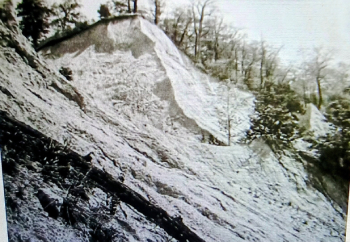
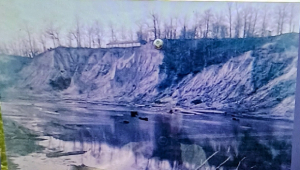
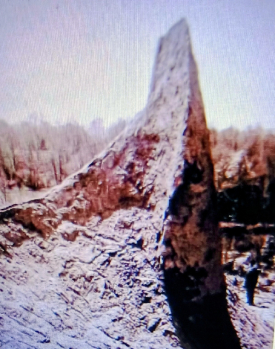
In the late 1800’s the Moraine Pinnacles were a popular picnic destination. I have mentioned in past articles, while picnicking at the Pinnacles, Orville and Wilbur Wright would lay a blanket down and not only enjoy the scenic overlook but observed the birds on the wind drifts coming up from the cliffs. The Wright Brothers weren’t the only people that had superb comments about this Moraine area.
According to the Dayton Herald newspaper article from Wednesday, April 29, 1891, the Herald writer talks about President Benjamin Harrison. “California is making a handsome display of its flowers for the President Harrison. We beg to say that if he would stop long enough in the Miami Valley, we will agree to furnish a climate equal to that of the Golden State, with forest and field unsurpassed in loveliness. At this time of year California is a little chilly, and southern Ohio this year merely excels itself. We should take the Presidential Party a drive down the eastern side of the Miami River (through Moraine) to as far as Carrollton, cross the river there and return through “the Narrows” and “Pinnacles”. The landscape has no ocean view, but plenty of the wide Miami, but such fields of wheat and budding forest trees, studded in a carpet filled with the tiny flowers of early spring, that his oratory would come like water over the “falls of Lodore”. The writer goes on to say, “the President (Harrison), why he would forget he had ever seen California”.
Just a week later, a May 6, 1891, Dayton Herald article states, “a man who went to collect botanic specimens remarked to a Herald writer that “the country in the vicinity of the Pinnacles is the most picturesque in the valley of the Miami. In the early spring and in the succeeding summer, floral attractions exist there in profusion, and the fishing in the Miami River is excellent”.
In the past 120 to 150 years have the Pinnacles changed? To find out, try hiking the 1.1-mile Wright Brothers Pinnacles Historical Trail and walk in their footsteps. Start at the South Trailhead off the Main Street Bike Bath or begin at the North Trailhead off the Pinnacle Road Bike Path. There are plenty of signs along the trail of vintage photos that the Wright Brothers took along the cliff plus other fascinating archeological finds here.
There is a Moraine connection between famous singer, composer, and record producer Stevie Wonder. Born Stevland Judkins in 1950 in Michigan, he has been blind since shortly after birth. Judkins was a child prodigy who signed with Motown’s Tamia label at age 11 and was given the name Little Stevie Wonder. At age 13, Wonder’s single “Fingertips” was a Billboard No. 1 hit in 1963.
Regarded as one of the most influential musicians of the 20th Century, Wonder is one of the best-selling music artists of all time with sales of over 100 million records worldwide. He has won 25 Grammy Awards and one Academy Award.
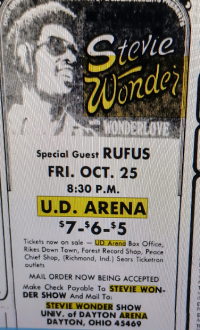
So, what was Stevie Wonder doing in Moraine on Friday, October 25, 1974? His fall 1974 Tour included a stop in Dayton. Wonder performed a concert at the somewhat new University of Dayton Arena built in 1969. The arena was packed full of people and his keyboard played hits like “Superstition”, “You Are the Sunshine of my Life”, and many more. Performing before Wonder was the band “Rufus” featuring future star Chaka Khan as the lead singer. An advertisement in the Dayton Daily News shows concert ticket prices at $5, $6 and $7 dollars.
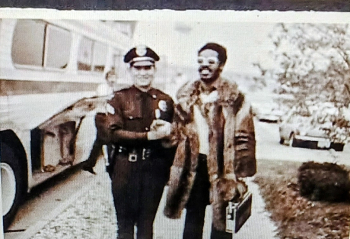
Before and after the concert, Wonder stayed at the Holiday Inn on Dryden Road in Moraine less than 2 miles from the arena. In the photos, Moraine Police Officers Wendell Wax and Joe Lawrence posed with Wonder after he exited his tour bus. Moraine PD provided outside security during Stevie Wonders stay at the hotel.
The following day Stevie Wonder said goodbye to Moraine and headed east for a October 26th gig in Charlotte, North Carolina and then on October 27th at the Spectrum in Philadelphia leaving behind Moraine Police and Holiday Inn employees, many memories and stories of his stayover in Moraine.
Dwyer Station was one of many small settlement names that lived and died by the Miami & Erie Canal. A section of the canal ran through Moraine and West Carrollton. On the banks of Holes Creek, it was named after the Dwyer Family, one of the area’s early settlers. Holes Creek is named for the county’s first surgeon Dr. John Hole, a member of the continental Army who moved here in 1797.
Dwyer Station was the site of a grist mill located on the creek and beside the canal. In fact, Dwyer Mill, Alexandersville, and the boat making Danville were all small communities that appear on old 1800’s maps that eventually become the cities of Moraine and West Carrollton.
Dwyer Mill, erected around 1826, was located on the southern border of Moraine and northern West Carrollton where the Interstate 75 northbound exit 47 now is. Farmers made week-long trips to the mill to have their grain turned into flour, sometimes waiting days for a turn. Farmers carried their grist to the mill on horseback carrying axes, food, gun, and ammo. By 1875 the mill flourished as it combined mill and distillery operations. In the 1930’s farmers brought their corn cobs to have them ground into hominy, wheat to make rye or white bread. Locals enjoyed rye, apple bounces and cherry bounces drinks for 12 cents a glass.
The mill at Dwyer Station continued to serve the area farmers until it was demolished to make way for the interstate in July 1960. This southern Moraine area has always been a transportation hub – an aqueduct for the canal, a wharf for boats on the Great Miami River, nearby railroad tracks for locomotives, traction lines for interurban rail cars and lastly, horse, stagecoach and then auto traffic on Dixie Highway.
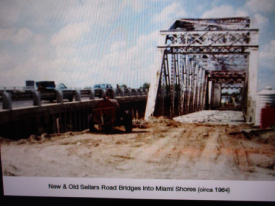
Sixty plus years ago the area around and across from the Moraine Municipal Building has changed much through the years. Back then Main Street was called Sellars Road. In the 1950’s if you were traveling east on Sellars Road across the old steel bridge (Photo#1) from Miami Shores and had a thirst or were hungry, you could turn right and along the riverbank was the popular and somewhat notorious Bonnie-Lee Café. Built in 1948 locals referred to the bar as Bonnie Lee’s. After the Miami River protective levee was built, the greenspace area from the former Bonnie Lee’s to Dryden Road was turned into ballfields owned by Montgomery County. Athletic Supervisor Fred Armbruster administered county adult softball leagues there for men and women. Locals called the ballfields Stinky Park due to the odors at that time that emanated from the nearby water treatment plant or river. Over time the two ballfields were removed, and the county uses the land for the Western Regional Water Reclamation Facility.
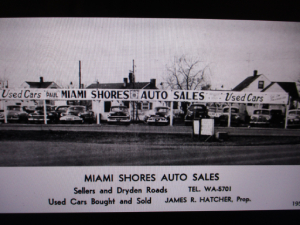
Across the street the Miami Shores Auto Sales was located at the corner of Sellars and Dryden where Proprietor James Hatcher bought and sold used cars (Photo# 2). The site later became a gas station/garage and then today’s Fat Daddy’s Road Hog Convenience Store and Marathon. Behind that area, in the 1930’s a park and greenspace was located along the river but through the years the Riverview Plat housing subdivision grew to over 55 homes.
Just southeast across Dryden Road, many senior citizens remember the old Quonset hut that sat on the land where the future Moraine Municipal Building was built in 1969
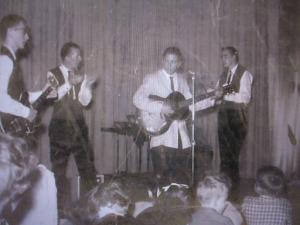
It was a rockin’ and a rollin’ good time at Moraine Fire Station #1 on Viking Lane when local talent Sonny Flaharty and his band performed in front of cheering Moraine youth. Many of our Moraine Senior Citizens reminisce about seeing him perform locally in the late 1950’s and the 1960’s. Thanks to the photo provided by Terry Neuberg who was in the audience, it shows the band (left to right Mike Flaharty, Keith Shadowen, Sonny Flaharty, Richard Shaman) performing at the Fire Station. Back in the early 1960’s, at least once a month the Moraine Fireman’s Association would pull all the fire equipment out of the bays and show movies, have holiday parties or have music concerts for the community.
Young Sonny Flaharty at age eight was singing in taverns for money. By the time the south Dayton native and Fairmont High School student was fourteen he put together his first group, Sonny Flaharty and his Young Americans Band. Sonny’s group traveled throughout the Midwest, opening for top musical acts such as the Rolling Stones, The Four Seasons, The Crystals and Bobby Vinton. He recorded “My Baby’s Casual” in 1958 which is in the Rockabilly Hall of Fame. From 1963 to 1967, Sonny joined the Mark V. The group played numerous club dates and were a regular fixture at Dayton’s “Diamond Club” where they opened for Little Richard, Neil Diamond, Jerry Lee Lewis, Bo Diddley, and the Ohio Players. They were signed and did records for Phillips Records, Warner Brothers Records and other recording companies. “Hey Conductor” (one of the biggest hits from Dayton ever) and “You Bring These Tears To Me” released in 1967 are their most well-known songs. Over the years, Flaharty played in other bands or on his own and recording rockabilly, rock and roll or middle of the road songs. Sonny’s last album titled “Old Stray Dogs Like Us” was released in 2014. But music is eternal and many Moraine residents remember the good old days when he performed here.
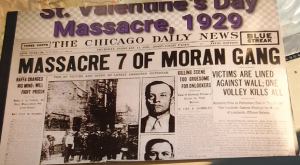
Could the ghost of a legendary gangster be haunting a Moraine Sports Bar? Did you know that former flashy Chicago gangster George “Bugs” Moran has a Moraine connection due to his 1946 robbery and kidnapping crime? Moran is forever linked to Chicago’s infamous St. Valentine’s Day Massacre. Mob Boss Al Capone was the leader of Chicago’s south side gang. Bugs Moran was the leader of the north side gang. On February 14, 1929, Capone’s gang (several dressed as police officers) machine gunned Moran’s top seven gangsters in a north side garage (Photo#1). Moran was late arriving or he would have also been killed. After the massacre Capone took control of organized crime and bootlegging in Chicago.
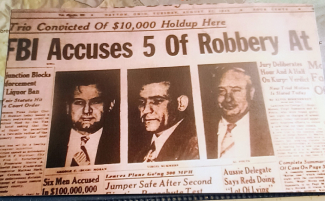
Fast forward to 1946 in Dayton, Ohio. Moran was not the big time crime boss that he once was in Chicago. He needed money and a new city to flex his muscle. Dayton, Ohio was a promising, blooming, industrial city. Along with Dayton bootlegger Al Fouts and Moran’s partner Virgil Summers, the trio of killers followed Silas Tavern bar manager Paul Kurpe, Jr. from Winters Bank on West Third Street. They forced Kurpe’s car off the road, kidnapped him at gunpoint and drove him to a wooded area on Vance Road (Photo#2). Kurpe was led into the woods, bound hand and foot and robbed of the $10,000 bank withdrawal that he was going to use to cash pay checks for workers at the nearby Frigidaire Plant in Moraine. Eventually, he got free and called police.
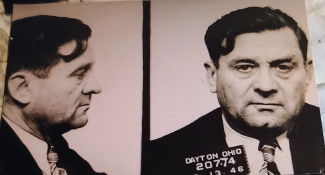
Within two weeks all three criminals were apprehended by Dayton Police (Photo#3) and the FBI with their trial being a big media sensation in Dayton. All three were convicted to 20 years in prison (Photo #4) where Bugs Moran eventually died in prison of cancer. The end of the story? Not quite.
Fast forward to 2017 in Moraine. City of Moraine employees Dave Miller & Jim Hall received a call from Upper Deck Tavern Manager Tammy Brackney. Brackney stated that during the past several years, Upper Deck (located at the corner of Blanchard Ave. and Springboro in Moraine) has had many paranormal claims, from waitresses feeling cold spots, hearing voices, having their hair pulled, hearing chairs being moved and footsteps. One female employee in the basement saw a full body apparition of a man with the meat slicer (Photo#5) being clearly seen through and behind him. The man wore 1930’s style clothing and a gangster style hat. Tammy was closing the sports bar one night, opened a storage room door & saw a shadow figure of a man. Since the building was locked at the time, a search revealed no other person in the bar. Brackney speculated that the ghost may be Roy Rogers (Photo#6), a patron who was killed in a homicide at the bar in the late 1960’s or a deceased man who once rented an apartment upstairs.
During historical research, Miller spoke with retired Moraine police officers and detectives who had worked the Rogers homicide case and found an incredible fact. Upper Deck Tavern had several different prior names through the years – John Bulls Restaurant & Sports Bar, The Lighthouse and Silas Tavern. Could the gangster looking apparition in the basement be the ghost of Bugs Moran who pulling his last big robbery heist 80 years earlier on the manager of this bar?
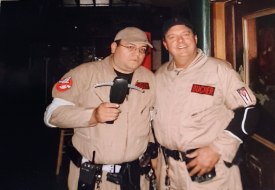
Hall, Miller, Brackney and Carin Bell (Photo #7) did a night ghost hunt investigation at Upper Deck on October 4, 2017. Around 2am, a loud slam was heard near the kitchen entrance. Upon investigation, both swinging doors were latched open and could not have made the slamming sound. Hall caught several elevated EMF readings on the first floor but debunked them as excessive wiring. The investigators along with local TV personality & writer Jim Bucher (Photo #8) and his two-man crew conducted a second investigation live on Facebook on October 18th. Tape recorders caught second floor doors being opened and closed while investigators were in the basement. Future investigations will be conducted. Today, few people realize that one of the nation’s top gangsters who battled Al Capone during Chicago’s bloody bootlegging era pulled his final kidnapping crime by robbing a Moraine, Ohio tavern manager. So, it’s funny to think that when patrons visited Upper Deck Tavern and sat eating a delicious burger, they may have not realized that “Bugs” may have not left the building! Recently, Upper Deck Tavern was sold and is being renovated to possibly become a Mexican restaurant. I have heard from a source that the new renovation has stirred up some strange occurrences. I hope that we can return and investigate there soon to see if we can find any evidence of paranormal activity.
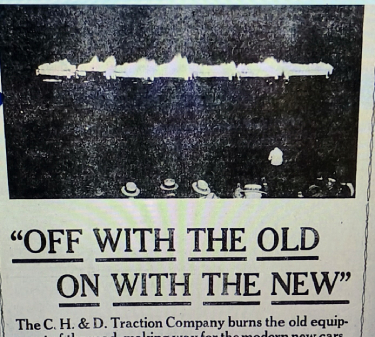
The June 23, 1927, Dayton Daily News headlines blared “Cremation is Attraction”. Despite the fact that famous aviator Col. Charles A. Lindburgh was in town and the interest in Dayton surrounded him, more than 25,000 people still attended the “cremation” of obsolete rolling stock of the Cincinnati, Hamilton and Dayton Railway Company at Moraine City.
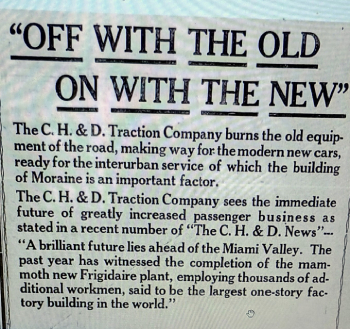
As the company burned the old Hills & Dales trolley cars, it celebrated at the same time the birth of a new child. The C, H & D Railway suddenly rose from being “one of the poorest” interurban traction lines in the country to one of the leading.
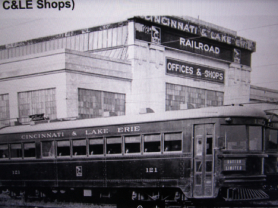
At the company’s new trolley barns and offices on Springboro Pike in Moraine City next to the Moraine Delco Plant, C, H & D Railway hosted an elaborate dinner for 450 people. This included city officials from all towns in the Miami Valley, newspaper reporters, YMCA officials, and leading railway men from across the country. Company speakers touted improvements such as the new modern generator station, new stronger rails along the track, new trolley car repair shops and new interurban trolley cars. C, H & D President Tom Conway stated that the electric interurban system’s trolleys moved over nine million passengers and 91,000 pounds of freight in 1926 with greater increases expected in 1928. The new trolley cars will reduce the 54-mile travel time from Dayton to Cincinnati by 15 minutes. The new Tuscan red trolleys were attractive, sturdier, more comfortable for passengers and would be on display in two days. Each trolley car seated 46 people in double-bucket leather upholstered seats.
Celebrating the company’s rehabilitation and rebirth, Conway stated that with the great industrial expansion in the Dayton area such as the new Frigidaire plant in Moraine, the trolley line expects to serve those workers and the population growth of the area.
Following the dinner, the large delegation boarded special traction line trolley cars and headed to a fireworks demonstration – planned to herald the company’s new improvements with an event dramatic enough to stir the imagination of the press and public alike. As the guests and the crowd of 25,000 assembled in a field just south of where today’s Moraine Walmart is located, C, H & D gave away free popcorn and ice cream and hired stunt pilots from Wright Field to put on an aerobatic show while a band played music. The Big Show aka The Big Cremation – bodies of the seven old wooden traction cars were placed end to end in a field in Moraine and given the torch. The cars were filled with kindling soaked in gasolene. The blaze could be seen for miles and burned over an hour. C, H & D management’s symbolism literally reduced the past to ashes and started anew with new trolley cars. It was quite the 1920’s marketing ploy.
The C, H & D electric interurban railway was absorbed in 1930 into the new Cincinnati and Lake Erie interurban railway. The C, H & D company building on Springboro Pike across from Voltz’s Root Beer Stand was demolished in 1999 by General Motors.
Many Moraine restaurants benefited greatly by establishing their location near the large Frigidaire plant (and future General Motors Assembly Plant) and marketing their menu and attractions to entice factory workers to stop in for breakfast or lunch and after work.
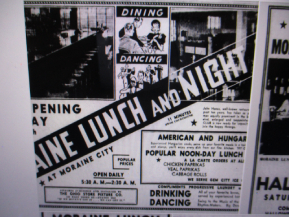
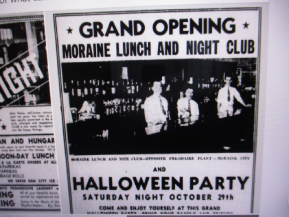
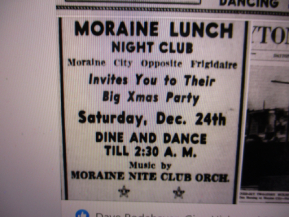
This one small building at the southwest corner of Blanchard Ave. and Springboro Pike across from the former Upper Deck Tavern has quite the history. The restaurant is called Moraine Lunch & Night Club which opened its doors in 1933.
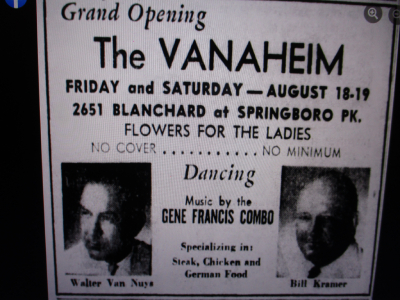
Moraine Lunch opened at 5:30am and closed at 2:30am and offered both American and Hungarian cuisine such as cabbage rolls, chicken or veal paprikas. Moraine Lunch offered food, drinks and dancing, marketing itself as a popular late evening attraction not just to Frigidaire workers but to the entire Miami Valley. The original 2-story wood-frame building burnt down in 1958. A new stucco-brick building was built in 1961 and opened as The Vanaheim. The Vanaheim restaurant offered good food and holiday dances but never achieved the success as Moraine Lunch.
Next door to Moraine Lunch was the infamous Moraine Smokery which did not offer any food nor smoke products and was raided for bookmaking horse races. Across the street was Silas Tavern which eventually became The Lighthouse which offered beer and light food for plant workers but not to the scale of Moraine Lunch & Night Club. Silas Tavern will always be remembered as its bar manager was robbed of $10,000 at gunpoint by famous gangster Bugs Moran in 1946. Moran’s gang was gunned down in Chicago a decade earlier by Al Cappone which was called “The St. Valentine’s Day Massacre”.
Although none of these restaurants exist today, they were important businesses in Moraine back in their time to feed the over 3,500 workers at the Frigidaire plant.
Peter Hetzel was a carpenter and manufactured fanning mills, hand-looms, and furniture. He was a co-founder of Zion Memorial Church on South Dixie Drive. His wooden frame farmhouse was built in 1817 and was located a mile east of the church just off West Stroop Road.
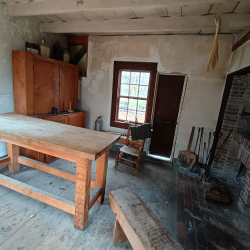
For about a year while the farmhouse was being built, Hetzel, his wife Catherine and their five children lived on site in a very small, white wooden frame building called a summer kitchen. A summer kitchen was used to keep heat out of the main house during hot weather. Pots were suspended from a crane for cooking or heating water. A bake oven was used to make bread, pies, and other baked goods. The Hetzel Summer Kitchen Building still exists today at Carillon Historical Park. The building is so small that you are amazed that seven people had enough space to live in it.
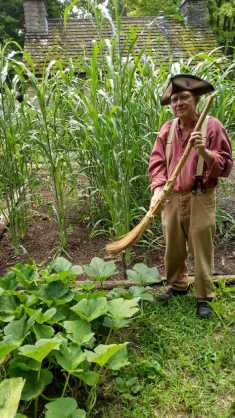
Outside beside the summer kitchen building is a garden where park staff grow vegetables that the Hetzels would have planted including a special plant called broomcorn. Broomcorn is not edible but once dried, its stiffer bristles are used to make brooms for dry sweeping only.
Here are four unique facts that you may not have known about Moraine.
(1)The city name Moraine is very rare. There are no other towns named just “Moraine” in the United States and only one other named Moraine in this part of the world – Moraine, Haiti.
On this Caribbean Island, Moraine is located in the region Centre of Haiti, 31 miles northeast of Port-au-Prince, the capital of this Republic. One source refers to Moraine as a rural populated area of around 5,000 people with everyone sharing one water source. Thousands of Moraine residents came to a single shallow spring of dirty water trying not to disturb the mud in the spring and dirty the water. During the dry season all Moraine people had to painstakingly preserve what little water they had. Fortunately, a religious based organization raised money and a water well was drilled providing the community (SEE PHOTO #1 & #2) with fresh drinking water.
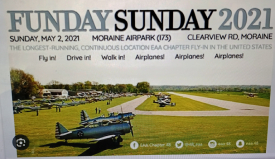
(2)Moraine is the home of the longest running same day EAA Fly-In in the United States. That’s right, the EAA (Experimental Aircraft Association) Chapter 48 at the Moraine Airpark on Clearview Road holds the Sunday Funday Fly-In on the first Sunday in May. The Fly-In began way back in 1959. Festivities consist of aviation booths, food & refreshments, and hundreds of vintage, experimental and regular airplanes on display. Hope to see you Sunday, May 4, 2025 for the 66th annual Fly-In!
(3)Moraine is home to one of the first seaplane bases in the world. Orville Wright began experimenting with adding pontoons to his regular airplane and testing them in 1912 and 1914 at the bend of the Miami River in Moraine and West Carrollton. He made over 100 flights. The seaplane base was on the riverbank on the Moraine side of the river near the east end of the Moraine Airpark’s runway. There is still debate whether the credit of the very first seaplane base in America goes to the Wright Brothers or to Glenn Curtiss of New York who began a seaplane base at about the same time.
(4) Lastly, Santa Claus almost lost his life back on December 24, 1904, at the small school at the Moraine Pinnacles. The children had assembled, and the Christmas program was almost finished when Santa (a local teacher) appeared. As he spoke to the children, he stood too close to a lighted candle and the cotton in his costume caught fire. In moments Santa was ablaze. Fortunately, billions of kids are still happy today and Moraine did not have the distinction as being the place where Santa Claus died. A teacher and others quickly tore off Santa’s costume. Santa completed his talk before the kids although slightly disheveled in appearance with his real hair singed. The school children quickly forgot about the fire and Santa as they received gifts and treats.