MORAINE’S INVOLVEMENT IN THE 1974 XENIA TORNADO DISASTER

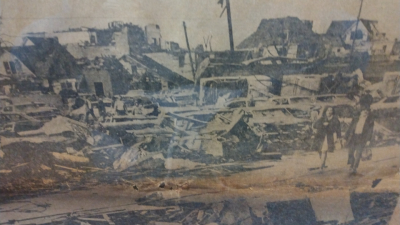
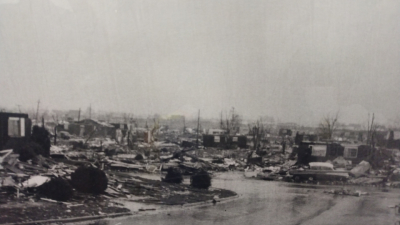
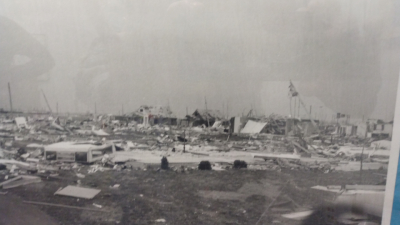
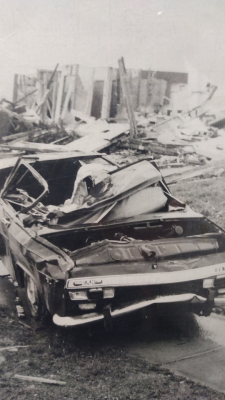
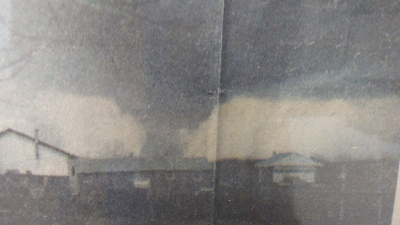
Wednesday, April 3, 1974 will never be forgotten in the Dayton area.  That was the day of the great Tornado Super Outbreak across east central United States that spawned 148 tornadoes in a 24 hour period that killed 319 people including the deadly tornado that ravaged Xenia, Ohio.  A total of 32 people were killed and 1,150 were injured in Xenia with $100 million in property damage in less than ten minutes.  The F5 tornado destroyed ¼ of the city and caused severe damage to another ¼ of the city. It was considered the worst of the 148 storms that hit that day. The year 2024 will mark the 50th anniversary of the tragic event.

I was nineteen years old working as a recreation leader for Moraine Parks & Recreation Department at the Moraine Meadows Elementary School Afterschool Recreation Program.  I remember that day, standing outside the school looking east as the swirling skies turned incredibly dark around 4:25pm, about five minutes before the tornado struck Xenia. The tornado entered western Xenia and completely flattened the Windsor Park and Arrowhead subdivisions then lifted and blew over several railroad cars as it entered and destroyed downtown.  Moving northeast it destroyed apartments, businesses, homes, churches, and Xenia High School. The tornado lifted up a bus and dropped it on the school stage where students had been practicing a play minutes before.

The next day on Thursday, April 4, me, and fellow city worker Steve Ward made flyers that were passed throughout Moraine Meadows Elementary School for residents to donate canned goods and clothing for the Xenia victims.  The following morning parents and children dropped off donations that filled up two City of Moraine dump trucks and my small car.  Our three vehicle caravan drove to Xenia, passed through the national guard checkpoint and dropped off supplies at Cox Elementary School.  I then drove throughout the ruined city and took hundreds of photos and super 8 film footage. The photos shown today are photos I took 49 years ago. By the way, don’t be fooled that Moraine will never be hit by a tornado.  Ohio averages 19 tornadoes per year with peak tornado season in Ohio from April through July. 

That wraps up our quick look at Moraine’s Involvement in the 1974 Xenia Tornado Disaster. 
MAUCH LABORATORIES

Sometimes good things come from the ashes of a terrible war.  Hence the story of “Project Paperclip” and how a Moraine businessman helped thousands of amputees.

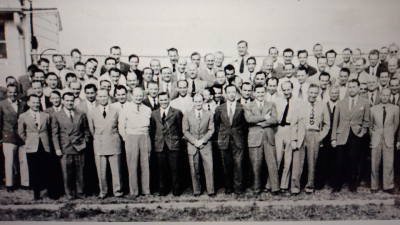
After World War II ended, convinced that German scientists could help America’s postwar efforts, President Harry Truman in September 1946 authorized “Project Paperclip”, a program to bring select German scientists to work on America’s behalf during the “Cold War”.  Over 1,600 Germans were relocated to America (Photo #1).

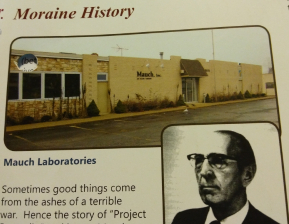
Hans Mauch was one such person.  Mauch had been a civilian engineer at the German Air Ministry from 1935 to 1939 and later acted as a consulting engineer for his own company. In 1946 he was recruited as a “Paperclip Scientist” and moved to Dayton, Ohio where he was employed at the Aeromedical Laboratory of the Wright Air Force Development Center. He left the Laboratory in 1957 to set up his own organization which was incorporated in 1959 as Mauch Laboratories Inc. on Dryden Road in Moraine.  Mauch Labs engaged in research, development and manufacturing in the biomedical engineering field.  The U.S. Air Force awarded Mauch the Outstanding Inventor Award in 1960. 

Except for a classified project to develop a space suit for the Air Force and NASA, Mauch Labs main work until the mid-1970’s was devoted to rehabilitation projects.  Mr. Mauch is recognized for developing the Hydraulic Knee Control System (Mauch SNS), a stance and swing hydraulic leg for above knee amputees.

Hans Mauch was a prolific inventor, a pioneer in prosthesis work, holding more than eighty patents on innovations that contributed to many fields including aviation and medicine.  He passed away in 1984 at age 78.

That wraps up our quick look at Mauch Laboratories in Moraine and Hans Mauch.  

HISTORY OF NEFF AIRPORT.

The land that eventually became Wax Park was once a dirt airfield. It was called Neff Airport or Neff Field and existed from 1947 to 1963. An 1800-foot grass runway ran north and south and was located where the Payne Recreation Center is today. Planes taking off to the north had to cross above the railroad tracks and gain altitude or steer east or west quickly to avoid the Pinnacles cliffs.

The 30-acre field in Miami Shores was owned, operated, and maintained by one man, Berlin Neff. Neff bought the land in 1944. The field had been used as an airfield before Neff acquired it but badly needed improvements. Neff cleared 200 to 300 trees from the landing field and its approaches so that he could qualify the airport for the GI Flight Training Program. In June 1947, Neff had 15 students in the program.

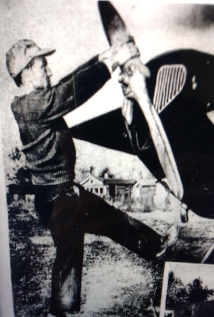
Berlin Neff, a former Delco Products worker, learned to fly in 1939 and was a former Army pilot from 1941 to 1943. He had enlisted in the glider program which folded when he was part way through the training and continued in service as an instructor in light planes.

With lumber sawed from the felled trees, Neff built five home-made hangers, added corrugated metal to the sides, and poured concrete floors to house airplanes. For the airport administration building, Neff moved a small one-story frame building to the field. It was elevated due to the problem of flooding in the area. Neff developed a recreation area for pilots and friends consisting of a small pond stocked with fish, stone fireplace, and badminton court.

A Montgomery County Engineer website 1949 photo shows (that is circled) the runway and the large circle which was a skydiving landing circle. The old Dayton Sport Parachute Club would jump there.

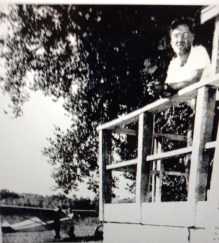
The Journal Herald Newspaper had an article on September 26, 1951, reporting where the pilot of a Stinson sports plane failed to gain sufficient altitude on take-off to clear the trees near the airport and the plane’s tail struck the trees.  The plane crashed upside down in an adjacent corn field. An adult and his four-year-old daughter received minor injuries as well as the pilot, who lived nearby on Willowview Drive in Miami Shores (Photo#4).

A Vultee BT13B #33 WW trainer plane flown from Neff Airport is now in the loft at the National Museum of the United States Air Force at Wright Patterson AFB in Dayton. It is blue and yellow, previously owned by Ray Brandly of WC, former President of the National WACO Club. That was a nostalgic look back at Neff Airport.

EAGLE FAMILY’S “NOAH’S ARK”.

I heard so many stories for a long time that I thought it might be an urban legend. After much research, I finally tracked down the truth. Some neighbors called it an “Exotic Zoo”.  Some locals who had never visited spread rumors that tigers and other wild beasts were caged there. Others said there was a witch that lived in the woods with all the beasts, and no one should enter the woods. Well, here’s the true story.

The Dayton Daily News, in a 1963 article, called it a “Private Kingdom and Private World” and wrote if the Eagle Family ever moved, it would take a second Noah’s Ark to move everything. 

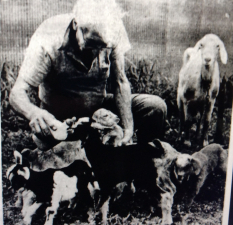
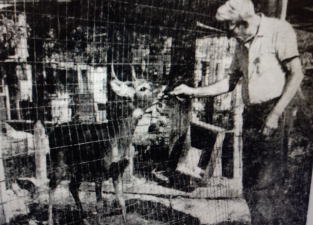
Branching off from the busy Pinnacle Road was a twisting private drive that ended with a house, a field and woods that was the private zoo and haven to over 150 animals including a burro, six raccoons (one of which was a rare albino raccoon named Pinky), four foxes, a peacock, geese, 30 goats, chickens, cats, crows, pigeons, doves, white rats, turkeys, over 2,000 white mice and that’s not all.  Pheasants, dogs, a deer, a mad squirrel, rabbits, honey bear, porcupine, chinchilla, guinea pigs, a skunk, cavies, badger, groundhog, and visitor favorites – Jerry the conti mundi; Robert, Molly, Mickey & Sammy the four rhesus monkeys; Jerry the Mynah bird and Lemmy the cacomistle.

This menagerie of critters was owned by Harold & Helen Eagle. Harold worked for over 45 years for the National Cash Register Company and Mr. Eagle spent most of his retirement money on providing over 50 trays of food per day to feed the animals. To help supplement the animal feeding, every day Harold would pick up donations of stale bread and baked goods, and in addition, he also sold rats to colleges and white mice to hospitals for experiments.

Neighbors, visitors, and school children sometimes by the bus load would stop by the farm zoo to see the animals. Very popular in 1963-1964 was a mother goat named Shelly who gave birth to quintuplets, five baby goats, which was a very rare occurrence. City of Moraine employee Barry Webb remembers, as a six-year-old, accompanying his grandfather Major Webb, who owned Webb’s Market in Miami Shores, and delivering groceries to Mrs. Eagle. Mrs. Eagle was very reclusive, had long fingernails and always wore a robe. Perhaps this is where the “witch” rumor came from. Barry said that Mrs. Eagle didn’t speak much but was very nice. Barry fondly remembers the peacock and petting the monkeys.

In the 1960’s, articles on the Eagle’s farm zoo appeared frequently in the Dayton newspapers. The Eagle’s farm and zoo were located at 3725 Pinnacle Road. The farm’s location was where Pinnacle Park Tot Lot on Charlotte Mill Drive is today long before Heather Hills subdivision was built.  Mr. Eagle died in 1964 at age 72 and Mrs. Eagle died in 1966 at age 77. Where all the animals went after Mrs. Eagle died no one knows but the memories of their private zoo, their love for animals, and the folklore lives on.

That was a nostalgic look back at the Eagle Family’s “Noah’s Ark”.

THE GREAT ALGONQUIN CLUB RAID

On August 24, 1934, the grand opening of the new Algonquin Club in Miami Shores took place with Don Burt and his orchestra performing, delicious sandwiches and beer available and as the Dayton Herald newspaper described “the club will provide an unusually attractive place for those who like dining and dancing”. 

However, Moraine senior citizens still talk about the day fourteen years later when the club was raided for illegal gambling. On March 6, 1948, at 4:25pm, Sheriff’s Deputies simultaneously raided the Algonquin Club, 3054 Sellars Road, and the Moraine Smokery at 2652 Edison Avenue (now named Blanchard Avenue). Both facilities operated illegal betting operations violating the state racehorse law.

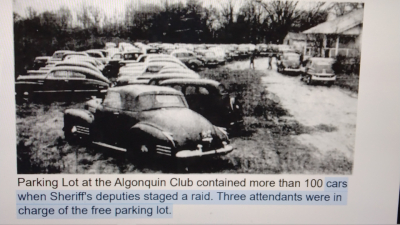
With 125 autos parked in the back or side of the club, a sheriff’s car occupied by two uniformed officers pulled in. A parking lot attendant who doubled as a lookout spotted the sheriffs car and quickly went into the club for a minute then returned. Two plain clothed deputies walked up and rang the club’s doorbell trying to get in. The lookout, not knowing they were deputies, told the two men they couldn’t get in right now with the sheriff’s car out front. The two plain clothes deputies broke the doors down and entered finding about 300 men and women making book on racing.  Deputies confiscated racing forms, betting slips and evidence against the owners. Herbert Rumberger, operator of the club was arrested.

Over at Moraine Smokery, located across the street from Frigidaire plant No.2, deputies found nearly 100 people inside gambling on horses. One man and wife, who seemed to be “in” on the news of the coming raid, decided to stay because she had never seen a raid before. Tim Sizer, operator of the Moraine Smokery handbook was caught by deputies stuffing handfuls of money into a canvas sack. Deputies did not find one display of cigars, tobacco, or cigarettes in the Smokery, but did find popcorn & soft drink vending machines, beer, pool table, loudspeaker, and blackboards listing the horse race tracks and betting instructions.

THE DAY ORVILLE WRIGHT ALMOST DIED IN MORAINE

Less than a decade after the Wright Brothers success of inventing, building, and flying the world’s first successful motor-operated airplane, Orville Wright began experimenting with a pontoon structure under the plane so that it could take off and land on water.

On Tuesday, August 20, 1912, almost 115 years ago, famed inventor and aviator Orville Wright’s life almost ended tragically testing a Wright hydroplane on an experimental flight in Moraine. The hydroplane took an unexpected plunge into the Miami River when making a turn. The plane was flying south in the morning to a point near the Moraine Pinnacles.

Several Wright hydroplanes (seaplanes) recently built in the factory here were sent east before being tested. Only two days after his 41st birthday, the experimental flight was Orville Wright’s first flight attempt in this plane. The hydroplane was about 20 feet off the ground when it suddenly dropped into the river. Orville was lucky. Due to the shallowness of the Miami River at that area, Orville suffered a hard blow over one eye but held on to a crosspiece and was not thrown from the plane. His hat was knocked off and floated downstream. Other than bruises, Orville fared better than a crash he had four years earlier in 1908 where he broke his left leg, three hip bones, four ribs and dislocated a hip.   

 Two men from a nearby camp and a farmer helped pull the battered hydroplane out of the water. The cause of the wreck – a workman had failed to attach the wiring to one of the blades of the plane.  Two days later the Dayton Herald newspaper reported that Orville stated that “experiments will be continued with more vigor than ever”.

Orville continued experimental flights after the plane was repaired. Wright continued to improve the hydroplane and performed over 100 flights along the Miami River in Moraine and West Carrollton within the next year. In fact, to celebrate Dayton’s 1913 Fourth of July Festivities, Orville scheduled to fly a hydroplane over the Miami River west of the Fairgrounds as part of the celebration.

WIZARD ISLAND & COZY ISLAND

The two island names sound like a couple of exotic Pirate’s isles in the south Caribbean but these two islands were once located south of the Main Street Bridge in the Miami River in Moraine.

You can see both islands clearly in the vintage photo. Cozy Island was small and just off Miami Shores.

Wizard Island was larger and located close to the eastern shore just north of the mouth of Holes Creek. Two senior citizens that I spoke to back in 2002 told me when they were kids in the summer they would canoe or swim out to Wizard Island. They would play for long periods of time or fish from the western side of the island.

Sadly, around 1959, both small islands were dredged up and the dirt from them was used to form the protective levee. On the plus side, this section of the Miami River was now wider and safer for boating and for seaplanes to land. 

THE HISTORY OF WAX PARK

The photo (circa 1890) is a view of the Wax Park area in Miami Shores taken from the Pinnacles, a bluff above the Miami River. The photo shows the CH&D railroad tracks, the gently flowing Miami River as it bends to the west toward West Carrollton and the undisturbed green space that 90 years later would become Wax Park. The majestic trees in the southwest corner of the future park are clearly seen in this vintage photo. This land in the photo was owned by the Apple Family. In the mid-1950’s part of the land was home to Neff Field, a small dirt runway which ran north and south which in time became the Moraine Airpark.

Eventually the city purchased the land and named it Recreation Park. Around 1980 it was renamed Wax Park in memory of beloved Police Lieutenant Wendell Wax who worked at the Moraine Police Division from February 1963 to July 1978.  He also served as Acting Chief of Police for 20 months. Wax passed away in July 1978 at age 47 during a hospital procedure. He is remembered for his dedication, his love for the City of Moraine and his concern for all citizens.  Wax Park was Moraine’s most popular park for many decades when recreational amenities were added such as the Natatorium Swimming Pool (built in 1972), Splash Moraine Waterpark & Payne Recreation Center (built in 1999), shelters houses and four ballfields.

Today, Wax Park is still a recreation hotspot as patrons come on their leisure time to picnic, enjoy the playground, walk or bike the one-mile paved walking path, or work out at the Payne Recreation Center. The City of Moraine hosts seasonal community-wide special events at the park such as the Moraine Police National Night Out, the Independence Day concert & fireworks, the BOO Bash and Community Halloween Party all of which draw thousands of patrons. The City of Moraine has developed a ten-year plan to make additional improvements to the park to ensure that it stays a vital recreation hub for the residents.

MAIN STREET IN MIAMI SHORES IN THE 1950’S & 1960’S

Coming over the old steel bridge and cruising down Main Street into Miami Shores 60 to 70 years ago was quite different from today. Back then Main Street was called Sellars Road.

The first businesses in the neighborhood, established to meet resident’s needs, were primarily grocery stores and service stations.  As the population grew after World War II, services were needed, and the Miami Shores Civic Association was formed in 1949 in an effort to secure those services.  Improvements eventually secured were streetlights for the neighborhood, a walkway across the two-lane Great Miami River steel bridge, installation of natural gas for homes and paved roads replacing old gravel roads.  Before the levee was built in the early 1960’s, many homes built on the Miami River shore had their own boat docks and two permanent ski jumps were built in the river. Around the corner from Sellars Road, Frank Nicholas Elementary School opened in September 1957 for students in grades 1 through 8 next to Starlite Café.

Just off Sellers Road, where Venetian Way and Swimming Hole Road are located, existed a former channel dug to bypass the river.  Residents swam in the channel for recreation or would access the river using canoes.  The channel by Venetian Way was eventually filled in and is now George Taylor Park. 

Walking west on Sellers Road you passed Goodwins Sohio Gas station, Mickey’s Beauty Shop, Brownies Sewing Shop, The Tradin’ Post (where you could buy everything from ice cream to paint), Webb’s Market (fruits, vegetables, meats and home delivery), a barber shop and Bucks Market, where you could buy Kwiki malts & dipped dogs, pure sorghum, big red cola cola for 10 cents a bottle, fruit, veggies & candy.  Just off Sellars Road on Clearview you had Humphrey’s Grocery & Meats. 

THE GREAT FRISCH’S BIG BOY FIRE OF 1959

A Moraine landmark as you enter Moraine from West Carrollton, Frisch’s restaurant has been at the corner of State Route 741 and Dixie Highway for 67 years. But did you know that the current Frisch’s was not the original restaurant built there?

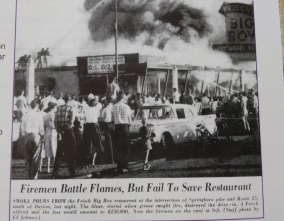
Prior to Frisch’s was the popular Lou’s Dude Ranch, since 1945, a popular fifteen booth restaurant and bar which offered music played on a Steinway Spinet piano with Solovox. The Country Kitchen chain of restaurants purchased Lou’s in 1956 from Louella Fair for $77,500, invested $70,000 in remodeling and turned it into a Frisch’s drive-in restaurant. Sadly, three years later a devastating fire burned down the restaurant and a second Frisch’s had to be rebuilt. Fortunately, no one was killed in the fire, but it made front page headlines in the Journal Herald on July 3, 1959.

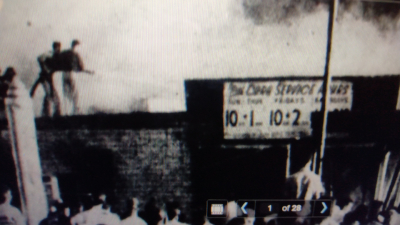
The blaze started when grease caught fire in the kitchen and quickly went up the grease flue and ignited a nearby gas line. The fire began during dinner rush hour with 70 to 100 patrons being served either inside or outside in their cars with a long line of customers waiting by the front doors. Nan Pritchard, a waitress on duty who lived nearby on Lauderdale Drive, said she knew there was a fire and thought it was not serious, but then the dining room filled up with smoke quickly and the waitresses yelled for everyone to get out quickly.

The Miami Township Fire Lt. Emil Emoning who lived nearby, came out of his house and said that Frisch’s kitchen “looked like a big bomb exploded”. When he got around to the front everything was blazing and the roof caved in 15 minutes later. Although Miami Township firefighters received the call at 6:45pm and had the fire totally out by 8:30pm, Somewhat hampering the fire department’s effort and tying up intersection traffic for several hours were about 2,000 people who watched the blaze from a very close vantage point. Loss was estimated at $250,000.

Moraine resident Jim Kuhns remembers that day. He was eleven years old back then. Jim and about eight other newspaper delivery boys were seated at the table with their newspaper Branch Manager and had just ordered drinks. The boys were being treated with a free dinner with awards to follow. A waitress came out and said, “Don’t worry about paying, there is a fire in the kitchen so please leave now.”

During the mopping up, children romped outside the building and one youth snatched bubble gum from a broken gum machine at the charred restaurant entrance.

Of note, you can see firefighters with water hoses (on the left of the photo) standing on one of the walls of the one-story brick and cement structure. The firefighters were not wearing protective coats, masks and other equipment.